

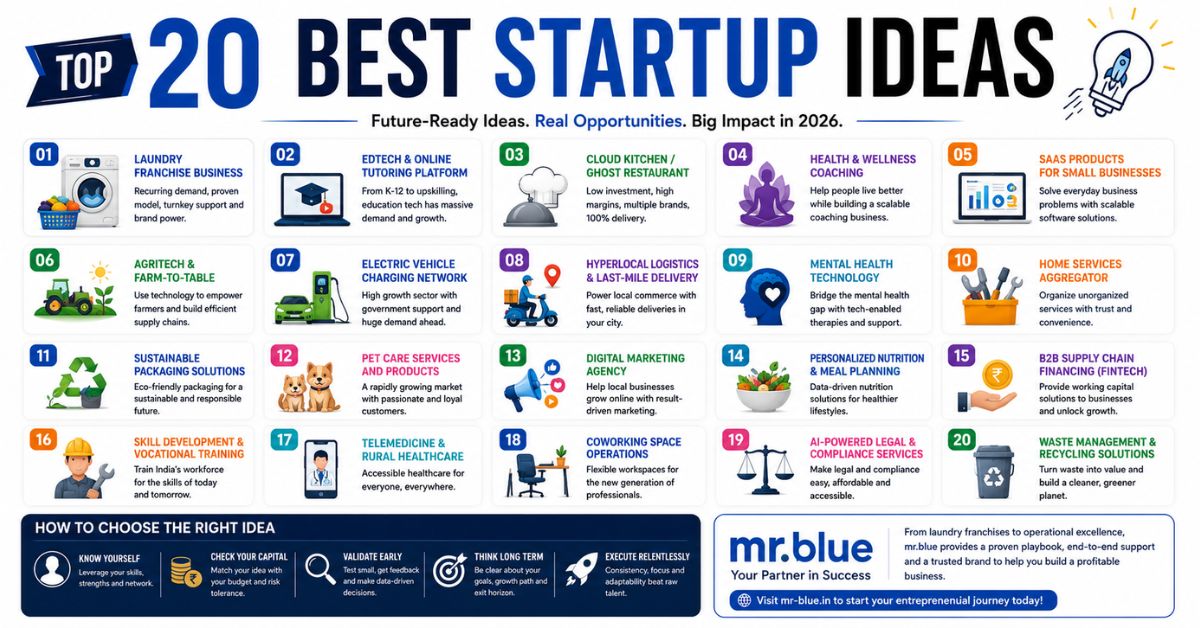
Do you have what it takes to start your own business? It takes more than passion to launch a successful startup. You need a scalable product or service that addresses demand and can grow with your company. But how can you identify such a startup idea? If you’re a first-time entrepreneur or business veteran looking to diversify your portfolio, finding the right idea will help you avoid startups that fail within months. In this complete guide, we will provide you with the top 20 ideas for startups that will really succeed in 2026.
These ideas range from service-based businesses to cutting-edge tech ventures. No matter if you’re looking to launch in metropolitan areas like Ranchi, Bengaluru, and Pune or up-and-coming Tier-2 and Tier-3 cities, the startup scene in India has never been more robust. So if you’re ready to take the jump, let’s dive in.
The Top 20 Startup Ideas Worth Pursuing in 2026
1. Laundry Franchise Business
Laundry franchise is one of the most lucrative business opportunities in urban India today. With increasing numbers of professionals, nuclear families, and students looking for convenience; demand for professional laundry services has been steadily growing.
The best part? It’s a recurring need, you can’t skip buying veggies, but you can skip laundry if you have dirty socks! Every week; people need clean clothes. Period. It’s recession-proof! Companies like mr.blue provide entrepreneurs opportunities to tap into this recurring need through a well established franchise model with turnkey operations support, technology and brand presence across cities. Starting a laundry franchise business means you don’t have to worry about creating processes, supply chain, or marketing playbook from scratch.
2. EdTech and Online Tutoring Platform
Education technology continues to be one of the fastest-growing sectors globally. From K-12 tutoring to professional upskilling, there is a massive gap between demand and quality supply. Starting a niche EdTech platform whether for regional language learning, competitive exam preparation, or vocational training can generate sustainable revenue through subscriptions, certifications, and live sessions.
3. Cloud Kitchen / Ghost Restaurant
The food delivery revolution has made cloud kitchens one of the most attractive low-investment, high-margin businesses. Unlike traditional restaurants, cloud kitchens require no dine-in infrastructure. Entrepreneurs can operate multiple virtual restaurant brands from a single kitchen and fulfil orders exclusively through delivery platforms, dramatically reducing overheads while maximizing reach.
4. Health and Wellness Coaching
Post-pandemic, consumer focus on personal health has intensified. Certified wellness coaches, nutritionists, and mental health practitioners are finding success offering one-on-one and group sessions online. With minimal infrastructure requirements and strong recurring revenue potential, health and wellness coaching is a startup idea suited for professionals transitioning from corporate careers.
5. SaaS Products for Small Businesses
India has over 63 million small and medium businesses, most of which remain underserved by software solutions. Building a SaaS product — whether a simple invoicing tool, an HR management system, or an inventory tracker — tailored to local business needs can achieve rapid adoption. The subscription model ensures predictable monthly recurring revenue.
6. Agritech and Farm-to-Table Solutions
India’s agricultural sector is ripe for disruption. Startups helping farmers with weather analytics, soil health monitoring, direct-to-consumer selling platforms, or precision irrigation tools are attracting both users and investors. The intersection of technology and farming offers enormous untapped potential in both Tier-1 and rural markets.
7. Electric Vehicle Charging Network
With India aggressively pushing EV adoption, the demand for reliable charging infrastructure is growing faster than supply. Setting up a network of EV charging stations in residential complexes, commercial spaces, or highway corridors is a capital-intensive but highly scalable startup that aligns with government incentives and policy tailwinds.
8. Hyperlocal Logistics and Last-Mile Delivery
E-commerce growth has created a persistent bottleneck in last-mile delivery. Startups that can reliably fulfil same-day or next-day deliveries within specific urban zones or pin codes command strong margins and loyal B2B clients. Hyperlocal logistics is especially viable in Tier-2 cities where national players often underperform.
9. Mental Health Technology
Digital mental health platforms are bridging the enormous gap in access to licensed therapists and counsellors. Whether through a therapy app, an anonymous peer support community, or AI-powered mood tracking tools, mental health startups are not only socially impactful but also commercially viable given growing consumer awareness and reduced stigma.
10. Home Services Aggregator
Plumbing, electrical work, carpentry, deep cleaning — demand for reliable home services is consistent and largely unorganized. A platform that verifies, trains, and aggregates skilled tradespeople with a strong customer experience layer can capture significant market share without requiring physical assets.
11. Sustainable Packaging Solutions
As brands race to meet ESG commitments, demand for eco-friendly packaging alternatives — made from recycled materials, biodegradable polymers, or agricultural waste — is growing across FMCG, e-commerce, and food sectors. Manufacturers and consultants in this space are finding ready clients.
12. Pet Care Services and Products
India’s pet industry is growing at over 20% annually. Startups in pet grooming, veterinary telehealth, premium pet food, and pet boarding are scaling quickly in metros and Tier-2 cities alike. The emotionally driven spending patterns of pet owners translate to strong customer lifetime value.
13. Digital Marketing Agency for Local Businesses
Millions of small businesses understand they need a digital presence but lack the expertise or budget for large agencies. A niche digital marketing agency targeting a specific vertical — such as healthcare clinics, real estate brokers, or restaurant chains — can build deep expertise and recurring retainer relationships.
14. Personalized Nutrition and Meal Planning
DNA-based nutrition, gut microbiome testing, and AI-powered meal planning are transforming how people approach diet. Startups that combine diagnostic testing with ongoing dietary coaching and meal kit delivery are building premium, sticky consumer relationships.
15. B2B Supply Chain Financing (FinTech)
Millions of small manufacturers and distributors face working capital crunches due to delayed payments. FinTech startups offering invoice discounting, supply chain financing, or revenue-based financing are addressing a massive credit gap with strong unit economics.
16. Skill Development and Vocational Training Centers
With a young workforce and growing demand for blue-collar skills, vocational training centers focused on plumbing, electrical work, welding, or cosmetology are viable both as standalone businesses and as franchise models. Government schemes like PMKVY provide additional financial support.
17. Telemedicine and Rural Healthcare
Bridging the urban-rural healthcare divide through telemedicine platforms, diagnostic networks, and pharmacy-at-home models addresses one of India’s most critical needs. Startups in this space attract impact investors alongside commercial interest.
18. Coworking Space Operations
Hybrid work has permanently expanded demand for flexible office infrastructure. Operating a boutique coworking space in a business-dense locality — especially in Tier-2 cities where national players are absent — can generate strong yield on commercial property with relatively predictable occupancy.
19. AI-Powered Legal and Compliance Services
Small businesses routinely overpay for or underinvest in legal and compliance support. AI tools that automate contract review, statutory filings, GST compliance, and regulatory monitoring are delivering professional-grade services at a fraction of traditional costs.
20. Waste Management and Recycling Solutions
Urban India generates over 62 million tonnes of solid waste annually, with recycling rates well below global averages. Startups building efficient dry waste collection networks, e-waste recycling facilities, or waste-to-energy conversion units are finding both commercial viability and policy support.
How mr.blue Helps You Turn Your Startup Dream Into Reality
Having a great idea to start with is one thing. Knowing how to actually do it is another ball game. Often you need operator expertise, a mentor and a proven blueprint to work from.
mr.blue is a professionally run laundry services brand with a standardized operating model ready to be franchised. It has years of lessons learned and insights on how to operate successfully. If you are considering entering the laundry and garment care industry mr.blue doesn’t just provide brand equity, it provides you with a playbook on how to choose a location, how to equip your shop, how to train your team and how to market your services along with support for the day-to-day operations.
Even if you aren’t interested in a laundry franchise, there is a lot to learn from how mr.blue has developed a standardized workflow, implemented quality assurance practices and created a support system for its franchisees. Visit mr-blue.in to see how you can offer superior service to customers in any category.
How to Choose the Right Startup Idea for You
With 20 strong options on the table, the challenge shifts from finding ideas to selecting the one that aligns with your strengths, resources, and risk tolerance. Here is a practical framework to guide your decision:
- Audit Your Skills and Network: List your professional expertise, industry contacts, and operational strengths. The best startup ideas leverage what you already know.
- Assess Your Capital Availability: Capital-light models (digital agency, coaching, SaaS) suit first-time founders with limited funds. Franchise models and infrastructure startups require meaningful upfront investment but offer structural support.
- Validate Before Investing: Run low-cost pilots, free consultations, landing page tests, or service trials before committing significant capital. Real customer feedback is more valuable than any market research report.
- Think About Your Exit Horizon: Some startups are lifestyle businesses; others are built for acquisition or IPO. Clarity on your long-term goal shapes every decision from fundraising to hiring.
From Idea to Execution: Key Principles Every Founder Should Follow
Great execution separates successful startups from failed ones far more than the quality of the idea itself. Here are the core principles that consistently distinguish thriving ventures:
Start with the customer problem, not the product solution. Entrepreneurs who fall in love with their product often miss the fact that customers only care about solving their problem. Obsess over the pain point, not the solution. Regularly speak to potential customers before building anything.
Build a lean minimum viable product (MVP) and iterate rapidly. Perfection is the enemy of progress in early-stage startups. Ship a working version as quickly as possible, gather feedback, and improve relentlessly. Agile iteration compounds into significant competitive advantage over time.
Track unit economics from day one. Know your customer acquisition cost (CAC), lifetime value (LTV), gross margin, and payback period from the very first transaction. Founders who ignore unit economics until Series A often discover structural flaws that are expensive to fix.
Final Thoughts
The “best” startup idea isn’t necessarily the most technical or well-funded, it’s the idea that meets a problem for your target customer, can be delivered to them at scale (and at profit), and plays to your strengths as a founder. Love the warm safety net of a franchise, the artistic expression of a SaaS, or want to change the world with agritech or mental health? There’s a business opportunity for you in 2026.
Study those who came before you, seek out mentors in the space, and continue putting your customers’ validation first when deciding where to allocate your resources. Winners in entrepreneurship aren’t always the ones who go big, first or with endless funding, they’re the ones who remain inquisitive, listen to their customers, and execute consistently.
Frequently Asked Questions
Is a laundry franchise a profitable business in Indian cities?
Yes, laundry franchise businesses have demonstrated consistent profitability in urban and semi-urban markets. Factors driving profitability include recurring customer demand, relatively straightforward operations, and the elimination of major startup uncertainties through franchise support. Brands like mr.blue have built models that help franchisees achieve operational efficiency and customer retention from early months of operation.
How much investment is typically required to start a startup in India?
Investment requirements vary significantly by business model. A digital or knowledge-based startup (SaaS, coaching, agency) can often launch with under ₹2–5 lakhs. Physical service businesses like laundry franchises, cloud kitchens, or coworking spaces typically require ₹10–50 lakhs depending on location and scale. Infrastructure-intensive startups like EV charging networks may require ₹1 crore or more. Always include 3–6 months of working capital in your initial planning.
What are the most important factors for a startup to succeed in 2026?
The most critical success factors include solving a genuine, recurring problem for a clearly defined target audience, maintaining disciplined unit economics, building an adaptable and mission-driven team, and iterating based on real customer feedback rather than assumptions. Market timing also plays a significant role — startups in sectors with strong regulatory tailwinds (EVs, mental health, agritech) enjoy structural advantages that purely market-driven startups do not.
How can I validate a startup idea before investing significant money?
Validation should happen before major capital deployment. Practical approaches include conducting structured interviews with 20–30 potential customers to understand their pain points, building a simple landing page to gauge interest and collect sign-ups, running a manual or low-tech version of your service to test demand without automation, and analyzing competitor reviews to identify unmet needs. The goal is to gather evidence that customers will actually pay for your solution, not just express interest in it.