

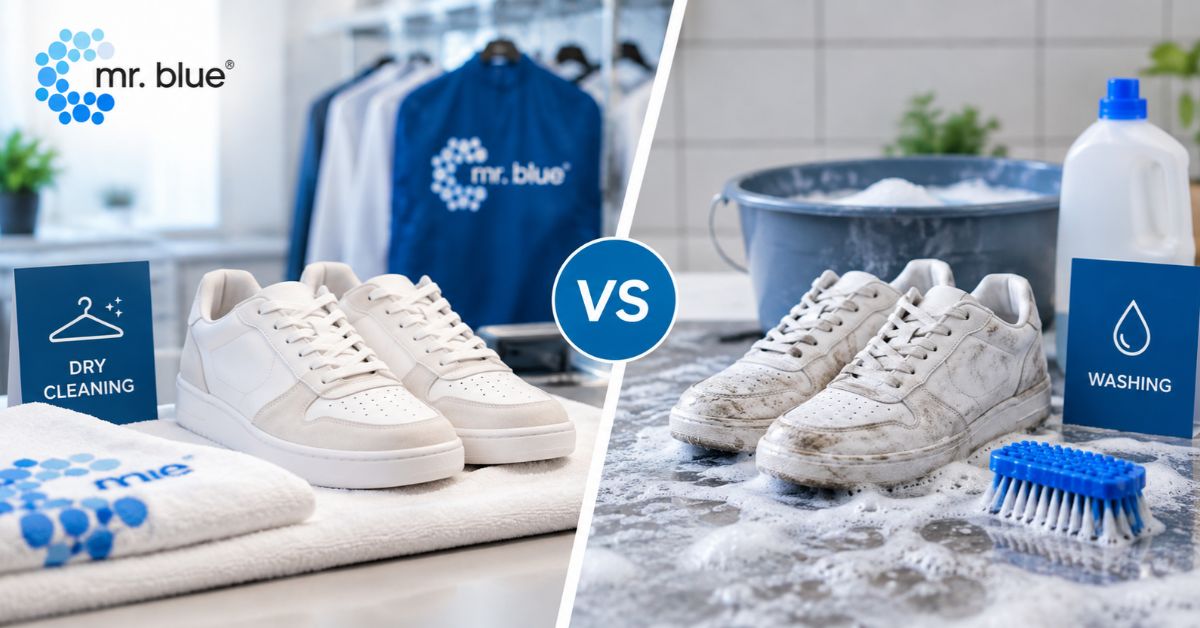
You’re sorting the laundry basket when you come across a shirt you’re hesitant to wash. Can you toss it in with everything else? Do you need to hand-wash it? Or is this a textile destined for the dry cleaner?
Dry cleaning and washing mainly differ in their cleaning liquid. Dry cleaning uses solvents, whereas washing involves water and detergent. However, you’ll know which method suits your item by reading its care label and examining its construction.
Let’s look at how each method works and where they’re better applied. Once you understand a garment’s care requirements, you can easily sort out what goes in the basket and what gets the drip treatment.
What Is Dry Cleaning?
Dry cleaning does not mean ‘cleaning without liquid.’ Clothing is cleaned using specialised equipment and solvent instead of water. It also includes extraction, drying and finishing steps.
Stains may require treatment before or after cleaning.
Dry cleaning is particularly useful for clothes that need a different approach to regular laundry. For instance, it keeps jackets, trousers and coats looking crisp and clean whilst retaining their intended shape.
Just because something requires dry cleaning doesn’t mean that it can automatically be cleaned using that process. Delicate trims or embellishments may prohibit it.
What Is Washing?
Washing involves water and detergent. The agitation helps loosen and remove dirt from the textiles in question. It could take the form of a machine cycle or delicate hand-washing.
Washing is what most people think of when it comes to clothing care. Yet even when your garment has an express instruction to wash it, that doesn’t mean you can just toss it in any way you please.
Temperature and cycles vary for specific reasons. Keep that in mind when comparing dry cleaning vs washing.
Dry Cleaning vs Washing: The Main Differences
| Factor | Dry cleaning | Washing |
|---|---|---|
| Main cleaning medium | Suitable cleaning solvents | Water and detergent |
| Where it happens | Professional cleaning equipment | At home or through a laundry service |
| Typical reason to choose it | The garment requires a process that avoids ordinary washing | The garment permits hand or machine washing |
| What needs checking | Label, materials, trims and construction | Label, temperature, cycle and drying instructions |
| Stain treatment | May require treatment beyond the main cleaning cycle | May require treatment beyond the main wash |
| Is it always the better option? | No; it must suit the garment | No; it must suit the garment |
The useful comparison is whether the process matches your clothes. A familiar routine should not outweigh the instructions on a new garment.
Start With the Care Label
Care labels use symbols to convey more than just whether you can pop something in the wash. Here’s what some of those symbols mean according to GINETEX.
| Label detail | Meaning |
|---|---|
| Crossed-out wash tub | Do not wash at home |
| Hand in the wash tub | Follow the specified hand-washing treatment |
| P or F inside a circle | Instructions for professional dry cleaning |
| Crossed-out dry-cleaning circle | Do not dry clean |
| W inside a circle | Professional wet cleaning |
Note the instructions printed on care labels too. If it says Dry Clean Only, use that as your guideline rather than experimenting with cold water. When in doubt about a garment’s care, ask for advice.
Which Clothes Should You Wash or Dry Clean?
Clear Washing Instructions
If your T-shirt, shirt or trousers have obvious washing instructions, then use the method it allows. You don’t have to dry clean favourite clothes that can survive a regular laundry routine.
Bear in mind each item’s care instructions when deciding what goes in your wash. Two apparently-similar shirts might have different washing needs.
Wool Jumpers and Other Woollens
Machine washing wool is perfectly fine on some garments. Others may need hand washing or dry cleaning instead. So how do you know which?
According to Woolmark, it all depends on what the label says. If your jumper is machine-washable, use the recommended settings and a gentle wool detergent. Then dry it as the label instructs. Flat drying is ideal, they advise.
The takeaway is to check what your jumper’s label says instead of treating all woollen clothes equally.
Tailored and Embellished Clothing
Clothes can have multiple fabrics with unique care requirements. Take bridalwear, for example. The outer material, lining, lace and beads are just some of the elements you might find on a single outfit.
Seek professional advice when you’re unsure how to best care for clothing. Visit Mr. Blue’s dry cleaning service and explain your garment’s construction before deciding what service you need.
Take along the garment and highlight areas you’re concerned about. Are there any loose trims? Has the colour been previously changed? Made any attempts to remove a mark yourself?
Does Professional Wet Cleaning Equal Normal Washing?
Professional wet cleaning differs from normal laundry. It involves water, yes, but also specialised equipment, products and finishing techniques.
GIINETEX points out this distinction if a cleaner suggests wet cleaning something you believed required dry cleaning. Ask them about their reasoning. Professional wet cleaning has its own symbol; it’s not an instruction to pop something in your household machine.
Which Is Better For Stains?
Stains and garments can affect which process works better. Method A might remove everyday soil while Method B treats that weird green mark.
When did the stain occur? Have you already tried to treat it? What methods and products did you use?
Our advice on caring for bridalwear provides a useful example. Food and drink marks may not seem too visible at first, but they can set and become noticeable if you wait too long.
Share with the cleaner:
What caused the stain, if you know.
When it happened approximately.
Whether you’ve washed or treated it previously.
What products you used when attempting home treatment.
Avoid expecting a miracle. Dry cleaning and machine washing can remove many types of stains, but neither can guarantee success.
How Should You Compare Cost?
Visit Mr. Blue to find our current quote and see whether the service is available in your area. On our official dry cleaning page, we mention that costs vary by location. So, we couldn’t provide a single flat rate to cover every order.
If prices seem high, find out what exactly you’re paying for before ruling out cleaner services. Does it include pressing? Will your item need additional treatment? When can you expect it to be ready for collection?
Once you know these details, you can make a more informed decision. It’s easier to choose a service when you understand what work they’ll perform and what you’ll receive in exchange.
Common Mistakes to Avoid
Assuming any two fabrics with the same name can be washed together.
Care labels apply to the finished article. Don’t expect a wool jumper to have the same care requirements as a wool coat just because they share material.
Thinking cold water equals safe washing.
Yes, cold is better than hot. But cold doesn’t mean you can ignore a “Do not wash” label.
Expecting every cleaner to offer the same service.
Confirm whether they’ll be washing, dry cleaning, or professionally wet cleaning your garment.
Never mentioning a stain’s history.
Inform the cleaner what you’ve done, even if that treatment didn’t help.
Neglecting to follow drying instructions.
Dry cleaning doesn’t mean skipping the dryer. Some items might even need ironing. Drying is just as important as washing and stain treatment.
Final Thoughts
Both dry cleaning and washing have their uses when it comes to clothes care. Read the label, assess the garment as a whole, and explain any stains before you commit to professional care.
Got a pile of laundry you’re wondering what to do with? Set any garments with unfamiliar symbols to one side. Research what they mean or visit Mr. Blue to double-check what services are available where you live.
Frequently Asked Questions
Does dry cleaning use water?
No. Dry cleaning mainly uses solvent as its cleaning medium.
Can you wash dry clean only clothes at home?
If your garment asks to be dry cleaned only, then dry clean it. Asking for advice doesn’t hurt if you’re looking for an alternative method.
Do I need to dry clean all wool clothes?
Not at all. Many wool items are machine or hand washable. Check what the garment’s label says and wash accordingly. Woolmark has some additional guidance if you need it.
I don’t see any care label on my clothing. Now what?
Consult the manufacturer if possible. Otherwise, bring your item to a cleaner and explain everything you know about it. Don’t assume you know the material based on how it looks or feels.