

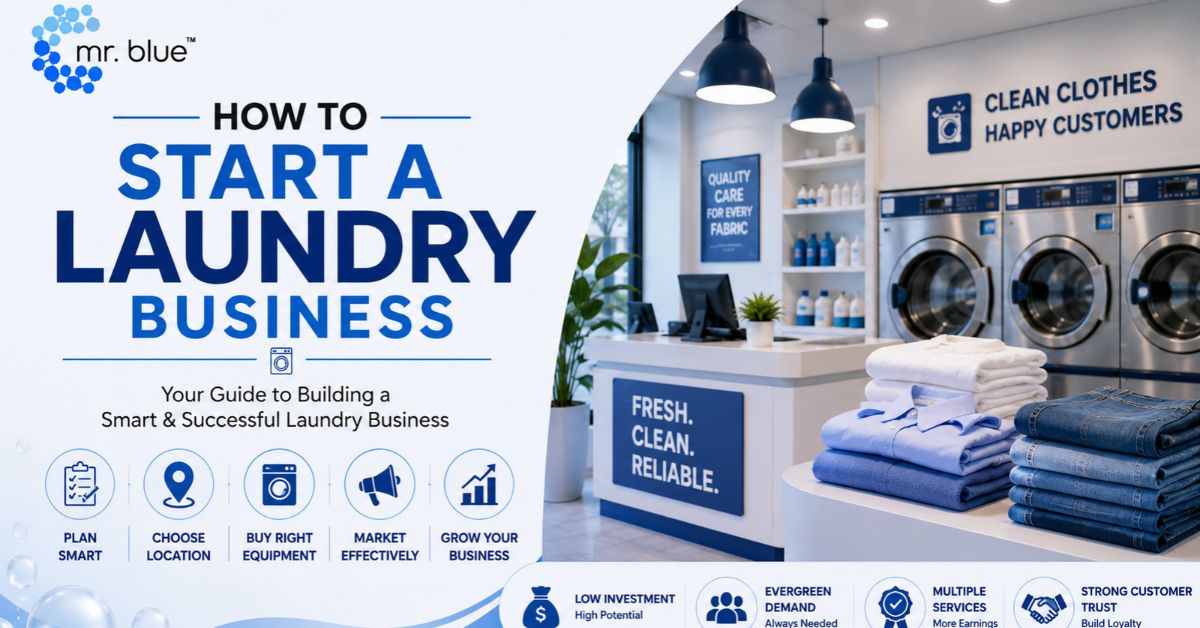
Laundry business has been one of the most recession-proof industries in the Indian Service sector. The laundry business does not come and go as trends do. People living in houses, hostels, hotels, hospitals have laundry loads every week that need to get cleaned. They are the reason you see many first-time entrepreneurs looking into laundry business options in 20-25. But how does one start a laundry business the RIGHT way?
So you have decided to start a laundry business. But where do you begin? Do you just go out and buy a washing machine, find a place to operate from and hang a sign board? No. There’s a lot more to a seemingly simple laundry business. From conducting market research to finding the perfect location to sizing your machines & fixing the right price to your services. And most importantly building processes that can scale along with your business and not break down when your orders start pouring in. Here’s a step-by-step guide to help you with what you need to know before starting a laundry service.
Why the Laundry Business Is Gaining Momentum
Lifestyles in cities have evolved in the past decade. Nucleus families, working professionals, bachelors and students staying away from home have fuelled a huge population that either doesn’t have time to wash their clothes or doesn’t have enough space to own a washing machine at home. Factor in the increasing number of hostels, PGs, co-liveings and boutique hotels and you have a consistent demand curve that trends upwards instead of oscillating up and down.
The other thing working in favour of new-age players is that the segment is far from saturated. Most cities boast of unorganised laundromats that are local operators and 2-3 organised players at best. It is this void that mr.blue, a Laundry Franchise Business fills- it provides an organised platform for entrepreneurs to enter the laundry business without having to start every process anew.
Step 1: Understand the Business Models Available
Before investing a single rupee, you need to decide which format suits your budget, location, and long-term goals.
- Self-service laundromat – Customers use coin or app-operated machines themselves. Lower staffing cost but requires higher footfall areas.
- Full-service laundry (pickup and delivery) – You handle washing, drying, folding, and delivery. Higher margins but needs logistics planning.
- Dry cleaning outlet – Focused on garments requiring specialized chemical cleaning; typically a premium segment.
- Franchise-based laundry business – You operate under an established brand with a tested operational playbook, standardized pricing, and vendor support.
- Hybrid model – A combination of walk-in service and online pickup requests, common in metro cities today.
Each model has a different capital requirement, staffing need, and break-even timeline. Choosing the wrong format for your location is one of the most common early mistakes new owners make.
Step 2: Research Your Local Market Thoroughly
Not every locality supports every laundry format. A residential area with a large student or working-professional population may respond well to a pickup-and-delivery model, while a commercial zone near offices might favor quick-turnaround dry cleaning.
Before finalizing your business plan, spend time understanding:
- The average household income and spending habits in your target area
- Existing laundry providers nearby and gaps in their service (speed, quality, pricing)
- Whether the area has hostels, PGs, hotels, or hospitals that could become bulk clients
- Local water supply and electricity reliability, since both directly affect operations
- Rental costs and footfall patterns if you’re considering a walk-in outlet
This research phase often gets skipped by first-time owners eager to launch quickly, but it’s what separates a business that survives its first year from one that shuts down within six months.
Step 3: Calculate Your Investment and Budget
Laundry business costs vary widely depending on scale. A small neighborhood setup with two or three machines can start with a modest investment, while a full-service outlet with industrial washers, dryers, ironing stations, and delivery infrastructure requires significantly more capital.
Your budget should typically account for:
- Equipment (washers, dryers, ironing/pressing machines)
- Shop rental or lease deposit
- Interior setup and signage
- Initial inventory of detergents, chemicals, and packaging material
- Staff salaries for the first few months
- Marketing and customer acquisition
- Working capital buffer for at least three to six months
Many aspiring entrepreneurs underestimate the working capital requirement, assuming revenue will cover costs from month one. In reality, most laundry businesses take a few months to build a stable, repeat customer base.
Step 4: Choose the Right Equipment
Equipment quality will impact how fast you can provide service, how much it costs you to run, and your customers’ satisfaction. Washers and dryers that are built for commercial use are designed to withstand continuous daily usage. Residential models will not last very long if they are heavily used.
Some things to look for when choosing your equipment are: what size machine you need depending on the amount of daily orders you expect to run, energy star ratings for water and energy usage, local service and parts support, and warranty from the supplier. Saving money on equipment just to buy it, can result in costly repairs and down time which leads to disappointment in your customers.
Step 5: Set Up Systematic Operations
A laundry business lives or dies by its process discipline. Clothes get lost, mixed up, or damaged when there’s no proper tagging, tracking, and workflow system in place. Successful operators build a clear sequence: intake and tagging, sorting by fabric type and wash requirement, washing and drying, quality check, folding or pressing, and finally packaging and delivery.
This is another area where structured franchise models add real value. mr.blue’s operational framework, for instance, standardizes this entire workflow so that quality remains consistent whether an order is processed in Delhi, Bengaluru, or any other city where the network operates. For independent operators, replicating this level of consistency manually takes months of trial and error.
Step 6: Price Your Services Correctly
Pricing too low to attract customers is a trap many new laundry owners fall into, only to realize their margins can’t sustain rent, staff, and utility costs. Pricing too high without establishing trust first can drive customers to competitors.
A balanced approach involves benchmarking against at least three to four local competitors, calculating your actual per-kg or per-item processing cost including utilities and labor, offering tiered pricing for wash-only, wash-and-fold, and premium ironing services, and introducing subscription or bulk packages for regular customers like hostels or offices. Reviewing your pricing every few months based on utility cost changes and demand patterns keeps your margins healthy without alienating your customer base.
Step 7: Build Your Marketing and Customer Acquisition Plan
Even the best laundry service fails without visibility. Local marketing works far better than broad digital campaigns for this business, since laundry is inherently a neighborhood service.
Effective approaches include registering on Google Business Profile with accurate location and service details, tying up with nearby hostels, PGs, and small hotels for bulk contracts, running introductory offers for first-time customers in the surrounding one to two kilometer radius, encouraging referrals through simple discount incentives, and maintaining WhatsApp-based order booking, since it’s the most familiar interface for Indian customers.
Step 8: Consider a Franchise Route If You Want a Faster Start
Franchise-Based Entry Points There is a reason that building out every system, vendor relation, and pricing model takes time and incurs actual trial-and-error costs. For faster market entry, consider franchised options. mr.blue has become a well-known player in this category because they offer a standardized business model with operations support, plus have a presence in multiple cities already.
There are several companies in the laundry space providing various combinations of brand awareness, equipment roll-outs, and tech-enabled laundry service operations. Be sure to compare what each franchisor actually offers in training, supply chain connections, and territory support.
Common Mistakes to Avoid
- Underestimating water, electricity, and detergent costs in monthly projections
- Hiring untrained staff and skipping a formal handling process for delicate fabrics
- Ignoring customer complaints about delays, which quickly damages local reputation
- Expanding to a second outlet before the first one is operationally stable
- Not having a clear system for garment tracking, leading to disputes over lost or damaged items
Final Thoughts
The laundry business rewards those who operate their business like a service business instead of a hobby. There is always demand. Entry can be moderate. And successful laundries are those who “get it right” on day one with operations, pricing and customer experience. Whether you decide to build your own business from scratch or consider a proven franchise model, the principles are the same, understand your market, invest in quality equipment and always strive for consistency.
Frequently Asked Questions
Is a laundry business profitable in India?
Yes, laundry businesses generally have steady demand and reasonable margins once operations stabilize, typically within the first six to twelve months.
What licenses are required to start a laundry business?
Common requirements include a local trade license, GST registration, and pollution/water discharge clearance depending on your city's regulations.
Is it better to start independently or through a franchise?
Independent setups offer more control but take longer to stabilize, while franchises like mr.blue offer a tested operational model that can shorten the learning curve.
How do laundry businesses attract their first customers?
Local visibility through Google Business Profile, tie-ups with nearby hostels or hotels, and introductory offers are typically the most effective early strategies.